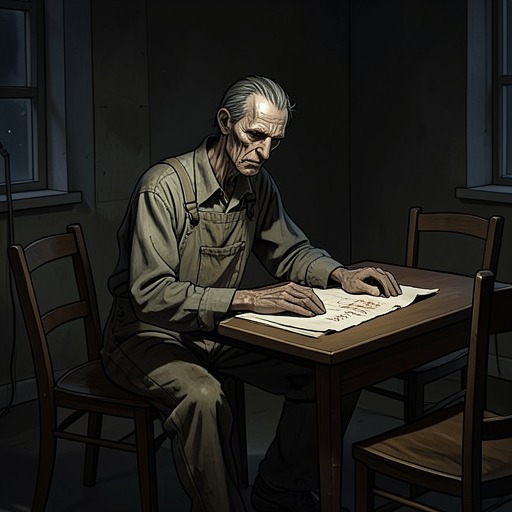
Frank Yearly and Janelle
Bones & AllFrank Yearly and Janelle’s relationship is both a love story and the fragile refuge Frank finds from a past he believes makes him monstrous. They build a life through shared work, friendship, and plans for a child; Janelle even learns Frank’s secret and continues to love him. But that acceptance cannot erase his uncertainty about what he might do. His departure leaves their daughter without the father he had hoped to become, and turns a summer remembered as perfect into a source of lasting grief.
Meeting and a Shared Life
Frank meets Janelle when he is twenty-two and working as a forest ranger at Laskin National Park. His duties involve patrolling campsites for people dumping trash or cutting their own firewood; Janelle takes entrance fees at the gate shack. On Frank’s first day, they laugh together at the sight of an inflatable woman in a red wig in a single man’s car. He remembers that small shared joke as the moment he knew he would always love her. Their attraction is immediate, but the memory also presents their intimacy as ordinary and companionable: it begins not with a grand declaration but with laughter during a working day.
When the summer ends, they arrange to stay in a caretaker’s cabin on Plover Lake, earning money by sweeping porches and checking that wealthy residents’ pipes do not freeze. Their life there is social as well as romantic. They make friends among the rangers—Sam, Flip, and Robby—and host them for Thursday-night drinks and poker in front of the woodstove. One winter, the lake freezes solid, and the group drives Flip’s truck out onto the ice for the thrill of it. Janelle has grilled cheese and hot cocoa waiting when they return. Frank remembers that she was not usually much of a cook, which makes the meal’s particular comfort part of the memory rather than a claim about domestic perfection.
The warmth of these details gives their shared past its force. The cabin, the woodstove, the risky drive across the frozen lake, and Janelle’s food form a life Frank can recall in specific scenes. He later records their summer in a small leather photo album titled Our Perfect Summer album. Its inside cover bears Janelle’s handwritten initials joined by a heart and the year 1980; the photographs preserve her in her ranger uniform, on horseback, and laughing over a sundae. For their daughter, these images make visible a period of happiness that she had not known about.
Marriage, Secrecy, and Acceptance
In the spring, Janelle’s parents come for the wedding. They try to be kind to Frank, though they resent not having had time to know him before he proposed. Janelle’s mother’s smile seems pasted on to him, and he fears she suspects his secret. Frank nevertheless describes her parents as good people and hopes that his daughter is close to them. His unease around them shows how secrecy shadows even the occasions that affirm his place in Janelle’s family.
Janelle does not know Frank’s secret before they marry. She senses that he is withholding something, but continues to love him without requiring him to disclose it. Frank takes that love as a possible way to keep the truth hidden indefinitely. Later, however, she learns what he has done as a child. He remembers her as someone who could make him forget he was a monster and believe he might live a good, honest life. Her acceptance does not depend on his being able to explain or undo his past; it offers him, for a time, a different understanding of himself.
Frank’s hope of becoming a father grows from the contrast between his own childhood and the family he imagines building with Janelle. He wishes he could be a real dad and promises himself that their child’s childhood will be nothing like his. When Janelle tells him she is pregnant, he wants their baby to love the woods, hills, and rivers that they love. Frank recalls that Janelle is happy during the pregnancy and sings lullabies through the day as though the baby has already been born. Reading his account, their daughter realizes that her mother wanted her and that, for a while, her existence made Janelle happy.
Fear and the Breaking Point
The relationship changes after an incident involving Robby. Janelle has taken a hotel job near Whippoorwill Lake so the couple can save money for the baby. One night, while she is at work, Robby arrives drunk and makes insulting remarks about her. Frank knows the remarks are lies, but cannot hear them without losing the ease of his memories of their summer. He orders Robby to leave and threatens to hurt him; Robby laughs. The episode makes betrayal by a friend part of the pressure surrounding Frank and Janelle’s home, but Frank’s account does not give a detailed description of what happens when Janelle comes home early. He identifies her return as the moment after which their relationship is altered.
Frank says that, from that night until he leaves, he feels both Janelle’s love and her fear. He cannot be sure that fear is not what keeps her with him, and acknowledges that he may be deceiving himself about it. The doubt persists even though he repeatedly assures her he would never hurt her, including in an argument. His account does not establish that Janelle’s fear is the sole reason she stays; rather, it records Frank’s inability to separate her love from the possibility that she is afraid of him.
When Janelle is eight months pregnant, she wants to move back to Pennsylvania. Frank wants their child to grow up in the landscape the couple loves. He understands that the disagreement is not only about where to live: he believes she wants to be near her parents because she is frightened. As he tells her this, she raises her voice and moves away, and he sees terror in her eyes. Frank leaves the cabin to think. He notices that Janelle no longer laughs, and believes he knows why. The scene brings together the two futures they cannot reconcile: the childhood he wants to give their baby and the safety Janelle seeks by leaving.
Departure and Lasting Consequences
Frank does not want to leave Janelle or their child. He says he knows he would never intentionally hurt either of them, but cannot be completely certain of that. His departure is therefore a choice made under the pressure of uncertainty, not evidence that his love has vanished. He is also afraid to write to Janelle because he fears she will not answer. He later regrets not writing, but believes it is too late. He describes Janelle as his sunshine and the knowledge that he will never see her again as the worst pain of his life.
The separation has consequences for both generations. Their daughter grows up with the absence of the father who had wanted to give her a different childhood, while Frank’s written account becomes her first sustained evidence that she was wanted. His memories complicate her understanding of her mother: the woman she could not remember laughing had once been joyful with Frank, and had sung to her before her birth. The relationship survives in the family not as a reunion but through the album, Frank’s testimony, and the daughter’s recognition that her parents had shared a real happiness.
Frank’s own childhood helps explain why the promise of family matters so much to him, without making his eventual choice inevitable. The Yearlys kept him after adopting him despite the mysterious circumstances in which he had been found, and he grew up feeling like an unsatisfactory replacement for Tom. Later, Frank confesses that as a very young child he ate a man who had taken him into a gas-station restroom. Janelle’s capacity to love him after learning this gives their relationship its central tension: she offers belonging where shame has taught him to expect rejection, yet he cannot trust that belonging to make his own nature safe. In retrospect, Sully’s later claim that Frank is his son places Frank’s secret within a larger family history, but it does not resolve the intimate question that shaped Frank and Janelle’s life together: whether love can overcome the fear of what he might be capable of.